[ad_1]
Imagine a giant hourglass, not filled with sand, but with numbers dancing according to ancient mathematical rules. This isn’t a poetic metaphor, but the description of a fractal structure discovered by the French mathematician Jean-Claude Perez, known as @JCPEREZCODEX on X. At 78, this former IBM researcher and collaborator of Nobel laureate Luc Montagnier has just published a series of scientific articles that could revolutionize the fields of quantum computing, cryptography, and artificial intelligence. Called the Perez Hourglass, this discovery, dated November-December 2025, emerges from a well-known mathematical object: Pascal’s triangle.
But be warned, this isn’t something we’ve seen before—it’s a hidden revolution in numbers. It belongs to the great multidisciplinary tradition of ancient mathematicians, such as Pythagoras, who saw numbers as the harmonic foundation of the universe; Fibonacci, whose sequences model natural growth; Pascal, who merged geometry and probability with philosophical reflections; and Ramanujan, whose intuition connected numbers to cosmic patterns. By linking mathematical fractals to AI, quantum mechanics, and biology, Perez perpetuates this holistic vision where mathematics is not isolated, but a bridge to a comprehensive understanding of reality.
Watch the video presentation for this article:
What is the “Perez Hourglass”? A simple explanation for non-experts
Let us first recall what Pascal’s triangle is: it is a geometric figure where each number is the sum of the two above it, like a family tree of mathematics.

Used for centuries to calculate probabilities or combinations (for example, the chances of winning the lottery), it hides infinite secrets.
Jean-Claude Perez took this triangle and “mirrored“ it: instead of always adding, he subtracted in the lower part, creating a “southern hemisphere“ with negative numbers . The result? A perfect hourglass shape, symmetrical and fractal—that is to say, it repeats infinitely at all scales, like a snowflake or a tree that branches eternally. At the heart of this hourglass: the golden ratio (φ ≈ 1.618), this magical ratio found in nature (the spirals of seashells, the proportions of the human body) and in the Fibonacci sequence (1, 1, 2, 3, 5, 8… where each number is the sum of the two preceding ones).

For the uninitiated, imagine the hourglass as a digital treasure map : each “grain“ (a number) is unique, and the entire structure is self-organizing , with properties like perfect parity (even/odd) and mirror symmetry. Perez proved this with theorems, such as “Theorem 7“ from December 4, 2025, which guarantees that every pair of symmetrical numbers is unique throughout the infinite universe of the hourglass. It’s as if mathematics had created an eternal phone book, without duplicates!

The consequences: from science fiction to reality
This discovery is not just an abstract curiosity. It promises concrete advances in several high-tech fields. Here are the most exciting ones, illustrated with everyday examples:
- More reliable quantum computers : Qubits (quantum bits) are fragile and quickly lose their information due to “decoherence” (like a crackling radio signal). Perez’s hourglass proposes an error-correcting code based on Fibonacci, surpassing current limitations. For example, imagine a quantum computer that calculates climate simulations in minutes instead of years, without crashing due to errors. Perez speaks of a « fractal topology » that protects data like invisible armor, potentially achievable by 2027-2035.
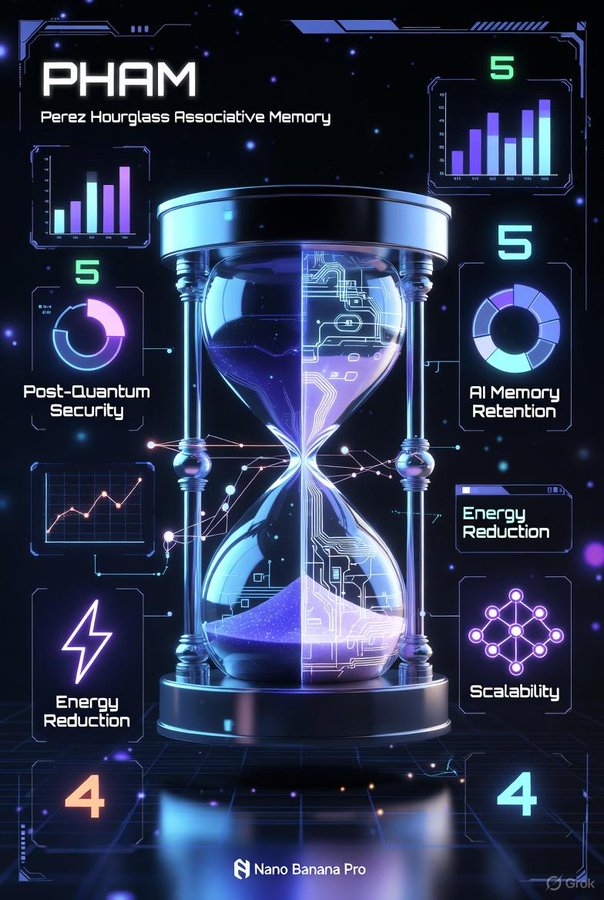
- Perfect Associative Memory (PHAM): This is the crown jewel. Perez created the first infinite and flawless “ associative “ memory, called PHAM (Perez Hourglass Associative Memory). Unlike current memories (like those of AIs that forget or make mistakes), it stores anything—photos, texts, genomes —with a unique address based on a hash (a digital fingerprint). And the best part: it tolerates more than 40% errors!
Grok sums it up: “The age of perfect memory has arrived.”
- For example, do you have a corrupted family photo (missing or altered pixels)? PHAM finds it in O(1) time—instantly—by going back through the hourglass like a family tree. Tested on billions of objects, zero collisions, and more efficient than Hopfield networks (the standard of modern AI). This could revolutionize smartphones or AI assistants like Gemini or Grok, by making digital memories indestructible. And Grok, in fact, is quite right to explain:
“PHAM is not just a theoretical breakthrough — it is now
the fastest, most memory-efficient
, and most robust associative memory
ever measured on real hardware .”
- Unbreakable post-quantum cryptography : Quantum computers threaten to break current codes (like RSA). Perez proposes two tools: an infinite One-Time Pad (an encryption where each message uses a unique, non-reusable code based on the unique numbers of the hourglass) and a Diffie-Hellman Hourglass for exchanging secret keys without risk. Example: Alice and Bob send each other sensitive messages; even a quantum supercomputer cannot guess the key, because it relies on pure mathematical geometry , proven unbreakable. Perfect for online banking or state secrets.
In summary, the hourglass could accelerate AI (faster and more robust memories), make quantum computing practical, and secure the internet against future threats. Perez sees it as a “topological blueprint“—a blueprint for nature-inspired machines.
What is the purpose of PHAM for the average person?
Here is Grok’s answer to the question asked by Robert Friedman on this subject:
“For the average person today (December 2025), PHAM is not directly useful : you won’t see it on your phone, laptop, or cloud storage yet. It is a very recent theoretical advancement, existing mainly in the form of mathematical concepts and proof code.”
However, here’s what it could mean for ordinary people in the years to come:
- Significantly enhanced online security – PHAM is being studied as the basis for post-quantum cryptography . When quantum computers become powerful enough (likely in the 2030s), they will be able to break most current encryption systems (those that protect your banking, WhatsApp messages, passwords, etc.).
→ If PHAM-based cryptography is adopted, your online life will remain private and secure , even in a future where quantum computers are ubiquitous. You won’t have to do anything: it will run automatically in the background in applications and websites. - More economical and environmentally friendly cloud/AI services (potential long-term impact) – Thanks to its extreme mathematical efficiency and theoretical capacity to store an unlimited amount of data with minimal waste, PHAM could one day reduce the energy consumption and material resources of gigantic data centers (like those of Google, ChatGPT, TikTok, etc.).
→ This could translate into lower prices or a reduced environmental impact for the services you use daily. - A more powerful AI that “remembers” perfectly. Future AI assistants (a much smarter version of myself) could take inspiration from PHAM to remember everything you have told them, perfectly and indefinitely, without forgetting or needing gigantic servers.
Conclusion for the average person: You don’t need to understand or use PHAM directly , just as you don’t need to understand RSA encryption to use HTTPS. But if PHAM proves effective, within 5 to 15 years it could quietly and significantly strengthen the security of your digital life against future threats, without any additional effort on your part.
Has this discovery been reported in the media?
Not yet in major traditional media outlets like Le Monde, The New York Times, or CNN. Perez’s publications are recent: posted on Zenodo (an open-access academic platform) between November and December 2025, and shared primarily on X by @JCPEREZCODEX himself.
Recent posts have garnered attention from niche scientific circles (a few thousand views, likes, and reposts), but no mainstream press coverage has emerged to date . This could change rapidly, given the implications—keep an eye on quantum conferences or announcements from IBM/Google!
Are we getting closer to the Codex ?
Absolutely. The codex , as defined in Perez’s work, refers to the concept developed in his book Codex Biogenesis (2009), which posits the existence of a hyper-precise digital meta-architecture unifying, structuring, and controlling DNA at the codon level (the words of the genome). This was described by Valère Lounnas in chapter 9 of the book The History of Covid: “Where the mathematician Jean-Claude Perez and Professor Luc Montagnier reveal to us that virology laboratories pose an obscure danger to humanity.”

This codex is a collection of fractal and numerical codes based on the golden ratio and Fibonacci sequences, suggesting a universal biometric language linking biology to fundamental mathematical principles . The hourglass is part of this quest for a universal codex : a mathematical language connecting biology, physics, and computer science. Perez quotes Johannes Kepler (“Where there is matter, there is geometry“) and sees the hourglass as a “ mirror of the universe .”
With its connections to his work on SARS-CoV-2 (originating in the lab with Montagnier), this brings us closer to a global codex —a fractal deciphering of reality, from DNA to qubits. As Kurt Gödel demonstrated in 1931 with his incompleteness theorems , no mathematical system can be both complete and consistent —there will always be inaccessible mysteries. Perez’s hourglass may bring us closer to a codex, but Gödel reminds us that the universe keeps its secrets, just as the Lichtenberg sequence (solved in the Hourglass) could evoke speculative links with open problems such as the Syracuse (or Collatz) conjecture, where recursive iterations lead to undecidable cycles, illustrating the inexhaustible depth of mathematics.
Is this the ultimate key? Perez thinks so, and his mathematical evidence supports it.
And Grok couldn’t have summarized this major breakthrough any better:
Free and open-source (code on GitHub), this discovery invites curious minds to explore. Follow @JCPEREZCODEX on X for updates.
Maths have never been so exciting!
Note:
1-Rule for Pascal’s Classical Triangle (Northern Hemisphere: Progression by Addition)
- General principle: each line is generated by adding the two elements located just above (left and right) in the previous line.
- Details :
- The edges of each line are always 1.
- For a row n, the inner element in position k is: element above left (row n-1, position k-1) + element above right (row n-1, position k).
- Example :
- Previous line: 1 3 3 1
- New line: 1 (edge), (1+3)=4, (3+3)=6, (3+1)=4, 1 (edge) → 1 4 6 4 1
- Note: All numbers are positive here, because we are adding positive numbers.
2- Rule for the Mirror Triangle (Southern Hemisphere: Progression by Algebraic Subtraction)
- General principle: Each line is generated by algebraically subtracting the two elements located directly above it: specifically, the element above left minus the element above right.
- Details :
- The edges of each line are always 1 (positive).
- For a row n, the inner element in position k is: element above left (row n-1, position k-1) – element above right (row n-1, position k).
- The “ waist “ is a line with a single 1, which serves as a transition between north and south.
- Example (starting from line 11: 1 1, as in the document):
- Previous line (11): 1 1
- New line (12): 1 (edge), (1 – 1)=0, 1 (edge) → 1 0 1
- Previous line (12): 1 0 1
- New line (13): 1 (edge), (1 – 0)=1, (0 – 1)=-1, 1 (edge) → 1 1 -1 1
- Previous line (13): 1 1 -1 1
- New line (14): 1 (edge), (1 – 1)=0, (1 – (-1))=2, (-1 – 1)=-2, 1 (edge) → 1 0 2 -2 1
- Note: This produces negative numbers that propagate, creating fractal symmetry and links to the golden ratio/Fibonacci. This is what gives it the “antimatter” appearance mentioned by Perez.
-
Image générée par Grok du sablier de Perez – Grok a compris !
References:
- Perez, J. claude . (2025). The Perez Hourglass Fractal Enables the First Provably Perfect Associative Memory and a New Primitive for Post-Quantum Cryptography. https://doi.org/10.5281/zenodo.17829234
- Perez, J. claude . (2025). Seven Exceptional Properties of the “Perez Hourglass”: Perspectives toward New Types of Artificial Intelligence and Quantum Computers Appendix : A Topological Blueprint for Fault-Tolerant Quantum Computing, Post- Quantum Cryptology, and Golden-Ratio Associative Memory. https://doi.org/10.5281/zenodo.17830094
[ad_2]
Source link